
Rice Filling Machine Manufacturer
Introduction
We at Shivam Control Systems, we take pride in being a leading manufacturer and supplier of cutting-edge Bagging Machines, Batching Systems, and Industrial Conveyors. Elevate your production efficiency with our state-of-the-art equipment designed to meet the demands of modern industries.
Rice is one of the most widely consumed food products in the world. With growing demand from households, supermarkets, restaurants, wholesalers, and food-processing companies, rice manufacturers need fast and reliable packaging solutions. Manual filling can take more time, require more workers, and may result in inconsistent quantities. This is where modern rice filling machines play an important role.
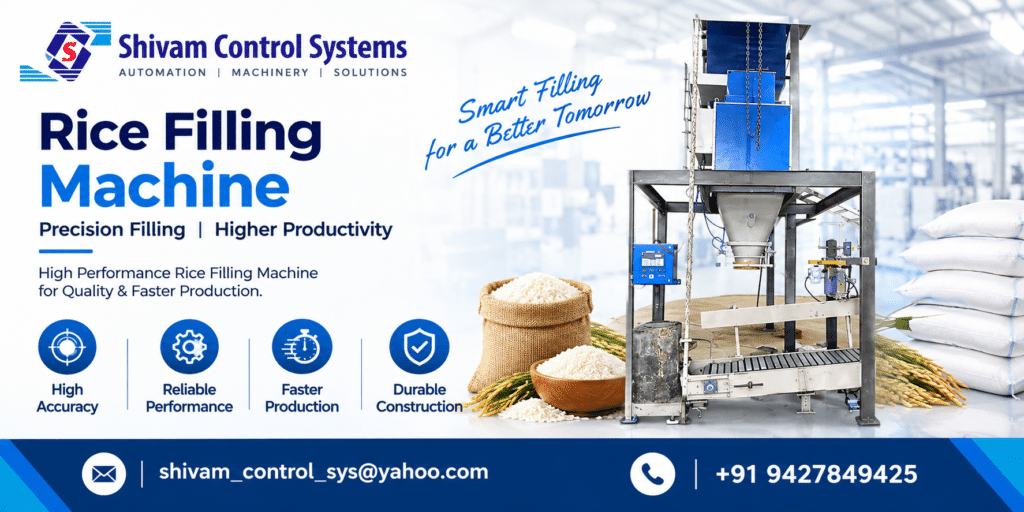
A Rice Filling Machine Manufacturer provides machines designed to measure and fill rice into different types of packaging accurately and efficiently. These machines can help rice processing and packaging businesses improve productivity, maintain consistent filling quantities, and reduce unnecessary material wastage.
Shivam Control Systems provides industrial automation and machine-control solutions designed to support modern manufacturing and packaging requirements. With a focus on reliable control systems, quality components, and practical solutions, Shivam Control Systems can be a valuable partner for businesses looking to improve their rice packaging operations.
What Is a Rice Filling Machine
A rice filling machine is an industrial packaging machine used to fill a predetermined quantity of rice into bags, pouches, containers, or other packaging formats. Depending on the machine design, rice can be measured using weighing systems or other controlled filling mechanisms.
The machine generally works through a series of steps. Rice is supplied to the machine, the required quantity is measured, and the measured rice is released into the packaging. The filled package can then move to sealing, stitching, labeling, or other packaging stages. Automation makes the overall process more organized and reduces the dependence on manual filling.
Why Is a Rice Filling Machine Important
Accuracy is an important part of rice packaging. Customers expect the quantity printed on a package to match the actual quantity inside. Inconsistent filling can create product loss and affect packaging efficiency. Packaging is an important part of the rice processing industry. Customers expect properly filled, clean, sealed, and attractive packages. For manufacturers and suppliers, accurate filling also helps reduce product loss and maintain consistency.
- Consistent filling quantity
- Faster packaging operations
- Reduced manual labour
- Better production efficiency
- Reduced material and product wastage
- Improved packaging consistency
- Easier operation
- Better control over production
A modern rice filling machine can provide controlled and repeatable filling operations. It can also support faster production compared with traditional manual methods. For rice mills, food-processing units, packaging companies, and bulk suppliers, an automated filling system can become an important part of an efficient production line.
Types of Rice Filling Machines
1. Volumetric Rice Filling Machine
A volumetric rice filling machine fills rice according to a preset volume. It is suitable for businesses that need simple and efficient filling operations. The machine can be adjusted for different pack sizes and is commonly used for regular rice packaging.
These machines are useful for medium-scale packaging operations where consistent filling speed is important. Their relatively simple design can also make operation and maintenance easier.
2. Weighing Type Rice Filling Machine
Weighing-type machines use electronic weighing systems to measure rice before filling it into bags or pouches. The operator can set the required weight, such as 500 grams or other quantities depending on the machine configuration.
This type is widely preferred when accurate weight control is important. A reliable Rice Filling Machine Manufacturer can design weighing systems according to the required capacity and packaging application.
3. Linear Weigher Rice Filling Machine
A linear weigher uses multiple weighing heads to measure rice before releasing it into the package. It is suitable for different production requirements and can provide controlled filling accuracy.
Linear weighing machines are commonly selected by rice processors and packaging companies that require flexibility in pack sizes. They can also be integrated with pouch packing and sealing systems.
4. Multihead Weigher Rice Filling Machine
Multihead weighing machines use several weighing heads to achieve fast and accurate product measurement. Rice is distributed across the weighing heads, and the system selects the required combination to reach the target weight.
This type of machine is suitable for high-speed packaging lines. It can help improve production efficiency while maintaining consistent filling performance.
5. Auger-Type Filling Machine
Auger fillers are generally associated with powdery and fine products, but specialized configurations can be used for particular granular products. For rice applications, the filling mechanism must be selected according to grain size, flow characteristics, and packaging requirements.
A manufacturer can recommend the appropriate filling technology after considering the type of rice and desired production speed. These machines can be suitable for small and medium-sized rice businesses that want to improve filling consistency without investing immediately in a completely automated production line.
6. Automatic Rice Filling Machine
Automatic rice filling machines are designed to reduce manual intervention during packaging. The machine can perform weighing or measuring and then discharge the required quantity into the packaging material.
Automatic systems are suitable for commercial rice mills and large packaging operations where higher production output is required. They can also be connected with conveyors, pouch-making machines, sealing machines, and coding systems.
Applications of Rice Filling Machines
1. Rice Mill Packaging
One of the most common applications of rice filling machines is in rice mills. After cleaning, grading, and processing, rice needs to be packed into suitable quantities for transportation and sale. A rice filling machine helps operators fill bags accurately and maintain a consistent package weight.
2. Retail Rice Packaging
Rice is commonly sold in different pack sizes such as 1 kg, 2 kg, 5 kg, 10 kg, and 25 kg. A modern rice filling machine can support packaging requirements according to production needs. Accurate filling helps create uniform retail packs and improves the overall appearance of the finished product.
3. Bulk Rice Packaging
Large quantities of rice are supplied to wholesalers, distributors, hotels, restaurants, and institutional buyers. For these requirements, rice filling machines can be used for filling larger bags and sacks. Automated filling helps reduce manual handling and supports faster packaging operations.
4. Basmati Rice Packaging
Basmati rice is often sold as a premium food product and requires careful packaging. Rice filling machines can be used for filling premium rice into attractive bags and pouches while maintaining the required quantity. Consistent filling also helps packaging companies maintain standard product weights.
5. Non-Basmati Rice Packaging
Non-basmati rice varieties are widely used for domestic consumption, commercial food preparation, and export. A rice filling machine can help package different varieties according to the requirements of the rice processor or distributor.
6. Food Processing Industries
Food processing companies that handle rice as a major ingredient can use rice filling machines for packaging finished rice products. The machine can become part of a larger packaging line that includes weighing, filling, sealing, coding, and labeling operations.
7. Rice Export Packaging
Rice exporters require consistent and dependable packaging for domestic and international shipments. Rice filling machines help fill bags according to specified weights before sealing and palletizing. Proper filling can contribute to organized packaging and easier handling during transportation.
8. Supermarket and Grocery Packaging
Packaged rice sold through supermarkets and grocery stores needs consistent weights and clean presentation. Rice filling machines help manufacturers produce standardized packages for different retail requirements. This is particularly useful for companies handling large numbers of packages every day.
9. Hotel and Restaurant Supply
Hotels, restaurants, catering companies, and food-service businesses often purchase rice in medium or large quantities. Rice packaging companies can use filling machines to prepare standardized bags for institutional customers, helping simplify storage, transportation, and inventory management.
10. Agricultural and Grain Packaging
Rice is an important agricultural commodity, and organized grain packaging requires efficient filling equipment. Rice filling machines can be integrated into grain-processing facilities where cleaned and processed rice is prepared for distribution.
Why Choose Shivam Control Systems
1. High Filling Accuracy
A professional Rice Filling Machine Manufacturer focuses on accurate product measurement. Consistent filling helps maintain the required quantity in every bag or pouch. This can reduce product wastage and support better quality control during packaging.
2. Suitable for Different Rice Varieties
Different types of rice can have different grain sizes, shapes, and flow characteristics. A reliable manufacturer can offer suitable machine configurations for products such as basmati rice, non-basmati rice, broken rice, parboiled rice, and other grain products.
3. Improved Packaging Speed
Manual filling can take considerable time, especially when production volumes are high. Automated rice filling machines can help increase packaging speed and maintain a consistent workflow. This makes them useful for businesses looking to handle larger quantities efficiently.
4. Better Production Efficiency
A properly designed filling machine can simplify repetitive packaging operations. Automated weighing, filling, and related processes can reduce unnecessary manual work and allow operators to focus on other production activities.
5. Customized Machine Solutions
Every packaging operation has different requirements. A reputed Rice Filling Machine Manufacturer can provide customized solutions based on bag size, filling capacity, rice variety, production volume, and available floor space. Customization can make the machine more suitable for a particular production setup.
6. Strong and Durable Construction
Rice packaging machines are generally used for continuous industrial operations. Manufacturers can build machines using suitable materials and components to provide strength and durability. Robust construction can help the equipment perform reliably in demanding production environments.
7. Easy Machine Operation
Modern rice filling machines are designed with user-friendly controls and straightforward operating systems. Easy operation can reduce the time required for training and help workers manage routine production tasks more efficiently.
8. Reduced Material Wastage
Accurate filling and controlled product handling can help reduce unnecessary rice loss during packaging. Better control over the filling process can contribute to improved material utilization and more economical production.
9. Consistent Package Quality
Uniform filling is important for maintaining a professional appearance and consistent package weight. A reliable machine can help businesses achieve greater consistency across batches, which is particularly useful for branded rice products and retail packaging.
How to Select the Right Rice Filling Machine
Before purchasing a machine, businesses should clearly identify their requirements. Start by determining the required package weight and daily production capacity. Next, consider the type of rice being handled, packaging material, required automation level, and available production space. When integrated with conveyors, weighing systems, sealing machines, and other packaging equipment, a rice filling machine can become part of a complete automated packaging line.
This approach can help create a smoother production flow and reduce unnecessary handling between different stages. It is also important to consider machine maintenance, operator requirements, control systems, and compatibility with existing packaging equipment. A professional manufacturer can help customers understand these factors and select a machine configuration suitable for their application.
The Role of Automation in Rice Packaging
Automation is changing the way food products are processed and packaged. Modern control systems allow machines to perform repetitive operations with better consistency and less manual intervention. Rice packaging is an area where automation can provide significant operational benefits. As demand for packaged rice continues across domestic and international markets, efficient filling systems can help packaging businesses manage their production requirements.
For rice packaging businesses, automation can help coordinate filling, weighing, conveying, sealing, and other processes. This can create a more organized production workflow. As demand for packaged food products continues to grow, efficient packaging machinery can become an important part of maintaining production capacity and quality.
Conclusion
A modern rice packaging operation needs speed, accuracy, consistency, and reliable control. A properly selected rice filling machine can help businesses improve productivity, reduce manual effort, control filling quantities, and create a more organized packaging process.
As a Rice Filling Machine Manufacturer solution partner, Shivam Control Systems focuses on industrial automation and control requirements that can support efficient packaging operations. From machine control to automation integration, the right system can help rice-processing and packaging businesses move toward more reliable and productive operations. For companies planning to upgrade their rice packaging process, investing in suitable filling and control technology can be an important step toward improving efficiency and preparing the production line for future growth.
