
Rice Bagging Machine Manufacturer in Gujarat
Introduction
We at Shivam Control Systems take pride in being a leading manufacturer and supplier of cutting-edge Bagging Machines, Batching Systems, and Industrial Conveyors. Elevate your production efficiency with our state-of-the-art equipment designed to meet the demands of modern industries.
Rice is one of the most widely consumed food grains in India and is also exported to many countries around the world. With increasing demand for rice, rice mills, food processing companies, wholesalers, and exporters need fast and accurate packaging solutions. Manual bag filling can take more time, require more workers, and may result in inconsistent filling weights. This is where a modern Rice Bagging Machine Manufacturer in Gujarat can provide an efficient solution.
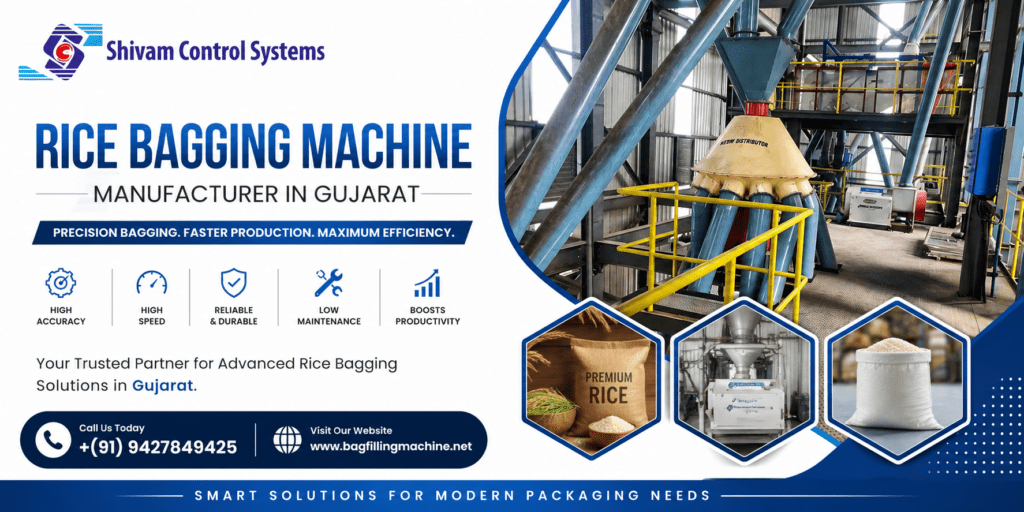
A Rice Bagging Machine Manufacturer in Gujarat provides advanced machinery designed to weigh, fill, and pack rice into bags with speed and accuracy. Shivam Control Systems is a trusted name offering reliable automation and packaging solutions for rice mills and other food-processing industries. Shivam Control Systems is a trusted name offering advanced industrial automation and packaging solutions designed to improve productivity, accuracy, and operational efficiency. The company provides reliable rice bagging machine solutions suitable for different rice packaging requirements.
What Is a Rice Bagging Machine
A rice bagging machine is an industrial packaging system used to fill rice into bags according to a predetermined weight. Depending on the machine design, it can handle different bag sizes and packaging requirements. Instead of depending completely on manual labour, businesses can use automated bagging equipment to achieve consistent filling and faster packaging. Depending on the model and configuration, the machine can handle different bag sizes and packaging capacities.
Traditional manual bag filling requires more workers and can result in variations in weight. An automatic or semi-automatic rice bagging machine improves productivity while maintaining consistent filling accuracy. Modern machines can be integrated with weighing systems, conveyors, bag-closing units, and control panels to create a complete packaging line.
Why Is Rice Bagging Automation Important
Rice mills can process large quantities of rice every day. Packaging this quantity manually can create several challenges, including inconsistent weights, increased labour requirements, slower production, and material handling difficulties.
- Accurate weighing and filling
- Faster packaging operations
- Reduced manual labour
- Consistent bag weight
- Lower product wastage
- Better production efficiency
- Easy machine operation
- Improved packaging consistency
For businesses looking to increase their packaging capacity, investing in an automatic bagging solution can be an important step toward improving overall productivity. The company focuses on combining dependable machinery with suitable control systems so that customers can achieve better control over their packaging operations.
Why Choose Shivam Control Systems
1. Strong Manufacturing Infrastructure
- Gujarat is one of India’s major industrial states and has a well-established engineering and manufacturing ecosystem. Ahmedabad and other industrial areas have numerous companies involved in packaging machinery, automation, material handling, and food processing equipment. This manufacturing environment allows buyers to source rice bagging equipment with different levels of automation and customisation.
2. Advanced Weighing Technology
- Accurate weighing is one of the most important requirements in rice packaging. Overfilling increases product loss, while underfilling can affect customer satisfaction and compliance. Modern rice bagging machines can use load-cell-based weighing systems to maintain consistent filling. This helps rice mills reduce unnecessary product giveaway and achieve more uniform bags. Depending on the machine model and product characteristics, manufacturers offer different accuracy levels and weighing ranges.
3. Faster Packaging
- Manual weighing and filling can take considerable time, particularly when production volumes are high. Automation can significantly improve packaging speed. Depending on the configuration, rice packaging machines available from Gujarat manufacturers can offer several bags per minute, while higher-capacity systems can achieve considerably higher output.
4. Reduced Labour Requirement
- Traditional rice bagging often requires workers for weighing, filling, moving, and closing bags. A modern bagging machine can automate several of these operations. An integrated system may combine weighing, bag filling, conveyor movement, and stitching or sealing. This reduces repetitive manual work and allows operators to focus on machine monitoring and quality control.
5. Customised Machine Solutions
Every rice mill has the same production requirements. Some companies need semi-automatic machines, while larger rice processing plants may require fully automatic packaging lines.
- Required bag weight
- Production capacity
- Bag material
- Available floor space
- Conveyor arrangement
- Stitching or sealing requirements
- Electrical and pneumatic requirements
6. Suitable for Different Rice Varieties
- Rice can differ significantly in grain size, shape, moisture level, and flow characteristics. Basmati rice, raw rice, parboiled rice, broken rice, and other varieties may require suitable feeding and weighing configurations. Modern bagging systems can be designed for different rice and grain applications. Some machines can also be adapted for products such as pulses, maize, wheat, seeds, and other granular products.
7. Different Bag Sizes and Packaging Materials
- Rice is sold in various packaging sizes depending on the target market. Retail products may use smaller bags, while wholesalers and institutional customers may purchase larger bags. A flexible rice bagging machine can be configured for different filling ranges. Manufacturers in Gujarat offer systems designed for various bag sizes and packaging materials, including PP woven, laminated, HDPE, kraft paper, and other suitable bags.
8. Integrated Bag Closing Systems
Filling is only one part of the packaging process. After filling, the bag must be properly closed to protect the product during transportation and storage.
- Bag stitching machines
- Heat sealing systems
- Bag conveyors
- Automatic bag clamping
- Batch coding systems
- Weighing systems
- Dust collection systems
9. Durable Industrial Construction
- Rice mills operate in demanding environments where machinery may run for long production hours. Therefore, machine construction is an important consideration. A quality rice bagging machine should use durable components and a robust frame suitable for continuous industrial operation. Product-contact areas may also be manufactured using suitable stainless-steel materials where hygiene and corrosion resistance are important.
10. Easy Operation and Maintenance
- Modern packaging machines are increasingly designed with user-friendly control systems. Digital displays, PLC controls, and touchscreen interfaces can make it easier for operators to monitor and adjust machine settings. Easy maintenance is equally important. A machine with accessible components, reliable electrical systems, and readily available spare parts can help reduce unnecessary downtime.
Application of Rice Bagging Machine
1. Basmati Rice Packaging
- Basmati rice is commonly sold in premium retail and export markets. Accurate weighing and gentle material handling are important because the appearance and quality of long-grain rice need to be maintained. Rice bagging machines can be configured to handle basmati rice efficiently while reducing unnecessary spillage during filling.
2. Raw Rice Packaging
- Rice mills producing raw rice can use bagging machines for regular bulk and retail packaging. Automated weighing helps maintain consistent quantities in every bag and can reduce product giveaway.
3. Parboiled and Boiled Rice Bagging
- Parboiled and boiled rice are widely supplied to wholesalers, distributors, food businesses, and export markets. A suitable bagging system can provide controlled feeding and accurate filling for different package weights.
4. Broken Rice Packaging
- Broken rice is used in various food and industrial applications. A rice bagging machine can help pack broken rice into bags of different capacities according to the customer’s requirements.
5. Export Rice Packaging
- Rice exporters require consistent weights, secure bag closing, and professional packaging. A complete rice bagging system can be integrated with conveyors, stitching or sealing equipment, and other packaging equipment to create a streamlined packing line.
6. Rice Mill Packaging
- Rice mills are among the major users of rice bagging machines. After milling, cleaning, grading, and processing, rice needs to be packed efficiently before storage or dispatch. A suitable machine can help rice mills reduce manual weighing and filling operations while improving packaging consistency.
7. Wholesale Rice Distribution
- Wholesalers and bulk distributors often handle large quantities of rice. Automated or semi-automatic bagging equipment can increase packing productivity and make the handling of larger quantities easier.
8. Food Processing Units
- Food processing companies handling rice and other grains can use versatile bagging equipment for regular production. Some systems can also be adapted for products such as pulses and other free-flowing granular materials.
8. Warehouses and Distribution Centres
- Large warehouses and distribution centres may need to repack or prepare rice bags for dispatch. A weighing and bagging system can help improve the speed of this operation. When connected with conveyors and bag-closing equipment, the complete process can become more organised and efficient.
Specification Table of Rice Bagging Machine
| Parameter | Specification |
|---|---|
| Material | Rice Bagging Machine |
| Application | Rice, grains, pulses and other free-flowing products |
| Filling Range | 5 kg – 50 kg per bag |
| Weighing Accuracy | ±0.2% to ±0.5% |
| Bagging Capacity | 10–30 bags per minute* |
| Filling Method | Gross Weighing / Net Weighing |
| Bag Type | PP, HDPE, woven, laminated and paper bags |
| Bag Feeding | Manual / Automatic |
| Bag Clamping | Pneumatic |
| Bag Sealing | Stitching / Heat Sealing / Optional |
| Product Feeding | Gravity / Vibratory / Pneumatic / Conveyor |
| Control System | PLC-Based Control Panel |
| Display | Digital HMI Touchscreen |
| Power Supply | 415 V, 3 Phase, 50 Hz |
| Machine Construction | MS / SS 304 as per application |
| Compressed Air | 5–7 Bar |
| Operating Mode | Automatic / Semi-Automatic |
| Suitable Industries | Rice Mills, Grain Processing, Food Processing, Agro Industries |
| Customization | Available as per production and bagging requirements |
Benefits of Rice Bagging Machine
1. Higher Packaging Speed
- One of the biggest benefits of a rice bagging machine is its ability to increase packaging speed. Manual weighing and filling can take considerable time, especially when handling large quantities of rice. An automated or semi-automatic bagging system can continuously weigh and fill bags, helping rice mills achieve higher daily production. Depending on the machine model, rice bagging systems can support different production speeds and bag capacities. Some machines available in the Indian market are designed for approximately 5–10 bags per minute, while higher-capacity systems can be configured for greater output.
2. Accurate Rice Weighing
- Weight accuracy is extremely important in rice packaging. Overfilling every bag can result in significant product loss, while underfilling can affect customer satisfaction and packaging compliance. Rice bagging machines generally use electronic weighing systems and load cells to measure the required quantity before filling the bag. This helps maintain more consistent weights throughout production and reduces unnecessary product giveaway.
3. Reduces Labour Dependency
- Traditional rice bagging often requires workers for weighing, holding bags, filling, moving, and closing them. A bagging machine automates many of these repetitive activities. This allows businesses to use their workforce more efficiently and reduces dependence on manual packaging operations. Automatic systems can integrate weighing, filling, conveying, and stitching into one continuous process.
4. Minimises Rice Wastage
- Rice wastage can occur because of inaccurate weighing, excessive filling, spillage, or improper bag handling. A properly designed rice bagging machine controls the flow of rice and provides a more systematic filling process. Controlled feeding and accurate weighing help reduce overfilling and spillage. This is especially valuable for high-volume rice mills where even a small amount of product loss per bag can become significant over thousands of bags.
5. Consistent Bag Quality
- Consistency is important for both retail and bulk rice packaging. A machine can help maintain similar filling levels and weights across batches. Uniform bags also provide a more professional appearance, which can improve the presentation of a rice brand. Automated packaging is commonly associated with consistent and professional final packaging.
6. Suitable for Different Rice Varieties
A well-designed rice bagging machine can handle different types of rice, including:
- Basmati rice
- Parboiled rice
- Boiled rice
- Broken rice
- Long-grain rice
- Other grains and pulses
7. Supports Different Bag Sizes
- Rice businesses may require different packaging sizes depending on their customers and markets. Industrial bagging machines can be configured for different bag capacities. Common applications include bags ranging from smaller commercial quantities to bulk bags of around 25 kg and 50 kg. Some systems are designed for broader ranges, such as 5 kg to 50 kg, depending on the machine configuration.
8. Better Hygiene
- Rice is a food product, so cleanliness during packaging is essential. Automated filling reduces unnecessary human contact with the product. Machines can also be manufactured with food-grade stainless-steel contact parts and designs that make cleaning easier. Dust-control and anti-spillage options can further improve the working environment around the packaging line.
9. Easy Operation
- Modern rice bagging machines can be equipped with digital weighing controllers, PLC systems, or HMI interfaces. These controls allow operators to set and monitor packaging parameters more easily. Once the required weight and operating settings are configured, the machine can perform repetitive bagging operations with less manual intervention.
10. Reduces Production Costs
- A rice bagging machine can contribute to lower overall packaging costs by combining several benefits: reduced labour requirements, faster production, better weight control, and lower product wastage. For a rice mill operating at high volumes, improving even one stage of the packaging process can have a noticeable effect on operating efficiency.
Types of Rice Bagging Machines
1. Automatic Rice Bagging Machine
- An automatic rice bagging machine is designed to perform the major packaging operations with minimum manual intervention. Depending on the configuration, the system can include automatic weighing, bag filling, bag handling, and discharge operations. It is suitable for medium and large-scale rice mills where high production speed and consistent packaging are required.
2. Semi-Automatic Rice Bagging Machine
- A semi-automatic rice bagging machine provides a balance between manual operation and automation. The operator may need to place or hold the bag, while the machine performs accurate weighing and filling. This type is useful for businesses that want to improve packaging efficiency without completely automating the packaging line.
3. Weighing Type Rice Bagging Machine
- A weighing-type machine uses a weighing system to measure rice before or during the filling process. Accurate weighing is one of the most important features of a professional packaging system because it helps maintain the required bag weight. These machines can be configured according to the packaging weight and production requirements of the customer.
4. Net Weighing Rice Bagging Machine
- A net weighing system measures the exact quantity of rice that needs to be filled into each bag. After achieving the programmed weight, the filling operation stops or changes according to the machine sequence. Net weighing technology is useful when weight accuracy is a major requirement.
5. Gross Weighing Rice Bagging Machine
- In a gross weighing system, the bag is positioned on the weighing platform and the product is filled while the complete package is being weighed. This type of machine can be suitable for applications where the bag is weighed during the filling process.
Conclusion
A reliable rice bagging machine can help rice mills improve weighing accuracy, packaging speed, labour efficiency, and overall production performance. With the growing demand for packaged rice, automated packaging solutions are becoming an important part of modern rice processing facilities.
If you are looking for a dependable Rice Bagging Machine Manufacturer in Gujarat, Shivam Control Systems can provide suitable industrial packaging solutions based on your operational requirements. With a focus on automation, accurate weighing, efficient filling, and practical machine design, Shivam Control Systems aims to help rice mills achieve smoother and more consistent packaging operations.
